Aircraft Sales Insights

A Service of Dallas Jet International

Fact or Fiction – You have to be a Fortune 500 Company to Afford a Business Aircraft

No Comments »

CitationV 300x207 Fact or Fiction   You have to be a Fortune 500 Company to Afford a Business AircraftBy Shawn Dinning, Dallas Jet International (DJI)

The vast majority of companies using business aviation–85%–are small and mid-size businesses and other entities, including nonprofit organizations. For every Fortune 500 company that relies on business aviation, there are several small businesses that also need their airplane. Our typical client range includes companies with revenues of $20 million annually up to over a billion, but some individuals and companies have far less than that.  The notion that only publicly traded companies own airplanes is very much a myth.  In some ways, owning an aircraft provides smaller companies more of a competitive advantage than the larger companies. They are differentiating themselves from their competitors by providing faster and more personalized service to their customers. Companies that own a private aircraft are more nimble, more responsive, and better able to take advantage of opportunities and respond to risks by ensuring their people are where they need to be, when they need to be there.  Studies show business use of general aviation adds value to a company’s bottom line.


But, let me change gears and caution prospective aircraft owners.  I see many companies and organizations realize the benefits of business aviation, at which point they become highly motivated to purchase a private aircraft.  While this is a successful revelation in every sense, I have seen these same individuals, companies, and organizations act in haste and become embroiled in a less-than-ideal ownership situation.  Examples of this scenario include acquisition of the wrong type of aircraft, purchasing an aircraft with poor pedigree and maintenance history, or having paid entirely too much for the aircraft.  In the aircraft business, whether you buy new or pre-owned, a seven figure blunder can happen in the blink of an eye.


Dallas Jet International is your partner in aircraft research, acquisition and all components of aircraft transactions.  We will help you acquire an aircraft that meets your travel requirements cost-effectively. We help you balance the initial investment with operating costs. We also provide options for reducing your cost, such as remote management and staffing using our alliances with major providers of those services.  Contact us to find out how we can assist with your situation.


Shawn Dinning, Director of Sales & Acquisitions

Mr. Dinning acquired his formal education at the United States Air Force Academy in Colorado Springs, Colorado, in the areas of Operations Research and Management Science and also holds a degree in Aeronautical Science from Embry-Riddle Aeronautical University. Mr. Dinning brings 16 years of aviation experience from a variety of aviation disciplines, including FAR 91, FAR 121, FAR 135, defense, and shared ownership sectors. A former full-time professional pilot, Mr. Dinning holds a current Airline Transport Pilot (ATP) certificate, and is type-rated in the Gulfstream V/G550/G500/G450/G400/G350/G300, Bombardier CRJ-200, and Citation 510 Mustang. He has logged over 5500 flight hours, with 3500 of those hours in corporate turbine aircraft. Mr. Dinning has been consulted in publications such as Business & Commercial Aviation on various issues related to turbine aircraft transactions.

Mr. Dinning brings to Dallas Jet International a rare and highly valuable skill set of operational and business acumen, and has become a leader in the professional marketing and procurement of corporate turbine aircraft all around the globe. He also specializes in aircraft mission analysis, aircraft valuation, and cash flow and operating cost analysis for private aircraft owners. Mr. Dinning has a track record of successful transactions that is well known amongst his clients and colleagues. His reputation for intelligent and meticulous management of aircraft transactions have made him one of the most respected aircraft brokers in the industry.

share save 171 16 Fact or Fiction   You have to be a Fortune 500 Company to Afford a Business Aircraft

Dallas Jet International on the cover of Executive Controller Magazine

No Comments »

Executive Controller, January 2012

Photo, Taylor Greenwood Photography

share save 171 16 Dallas Jet International on the cover of Executive Controller Magazine

An Emphasis on Relationships with an Operational and Technical Perspective

No Comments »

nara An Emphasis on Relationships with an Operational and Technical Perspective

Dallas Jet International was selected to be featured National Aircraft Resale Association’s blog.  Here’s the article:

Professionals who pride themselves on prioritizing the focus of each transaction appropriately own Dallas Jet International (DJI).  Long-term relationships come first, business objectives second, and aircraft third.  This long-term focus and emphasis on the people and business that the aircraft will be serving ensures that each decision is made in the best interest of the client, many of whom have relied on DJI to represent their interests in multiple aircraft transactions over many years.


DJI is owned and managed by former professional pilots and aircraft managers, who stay current and active during the free time away from the business. President and CEO, Brad Harris, and Managing Director of Aircraft Sales, Shawn Dinning, are experienced ATP pilots with current type ratings in 13 different aircraft from Citation 500 to Gulfstream G550, and over 13,000 flight hours between them.  An aircraft sales professional with an operational and technical background can more fully assess and appreciate a particular aircraft’s strengths, weaknesses, opportunities and risks. Harris and Dinning use this depth of knowledge to their clients’ advantage.


DJI operates independently and is at liberty to transact within any make or model of aircraft. Their sole criteria is to ensure the best match with the client’s needs, exclusively representing buyers during aircraft acquisitions, thus preventing conflicts of interest.  Harris and Dinning rely on excellent strategic market intelligence, ability to negotiate, and expertise with complex transaction structures for clients with diverse financial positions and strategies. They use the latest technology to research and list aircraft; and have cultivated an extensive network of industry relationships to find information and aircraft unavailable to many competing brokers and agents.


DJI has managed numerous aircraft in the past, and continues to manage aircraft for certain local clients.  DJI clients now have access to one of the industry leading charter/management and maintenance operations with DJI’s announcement of its brand new business alliance with Pentastar Aviation, a large Pontiac, Michigan-based Charter/Management and MRO (maintenance) company.  While brokering aircraft transactions is a large part of DJI’s business, the purchase of aircraft into inventory for resale is becoming an increasingly big part.  DJI is putting the message out to owners, brokers, banks, etc, that we are in the market to buy aircraft, including trade-ins and repossessions.


“Buyers and sellers need expert representation in the business aircraft marketplace,” explains Brad Harris. “We manage the complexities of the process from start to finish to our clients’ advantage.  While we are often labeled as ‘brokers,’ our clients call us ‘trusted consultants’ who rely on us to buy, sell or manage their aircraft in a manner that meets their objectives with the best possible financial results.”  Shawn Dinning adds, “Never underestimate the value of a reputable broker.  Our clients benefit from the fact that aircraft buyers and sellers (who are not represented by DJI) prefer to work with clients represented by DJI because they know they will have a smooth transaction process.”  Dinning advises anyone who is hiring a broker to really get to know that firm’s background, aviation experience, and reputation within the industry.


Founded by Brad Harris in 2001, Dallas Jet International joined the National Aircraft Resale Association (NARA) in 2008.   DJI’s clients benefit from  the global collective knowledge, and the industry benefits from the ideals of the group, which defines and maintains the highest professional standards.


For more information about Dallas Jet International and their capabilities, visit their website at www.dallasjet.com or call the Southlake, TX, office at 817.328.2900 or the Dallas, TX, office at 214.459.3303.

share save 171 16 An Emphasis on Relationships with an Operational and Technical Perspective

Fact or Fiction? “Buying an Older Airplane Can Save Me A Ton of Money!”

No Comments »

You’ll find that in today’s market it is possible to buy a Gulfstream III for under three million. That sounds really attractive, until you learn that your first major inspection is going to cost you $500,000 to $1 million; whereas a newer Gulfstream IV will have a purchase price of seven million but your first major inspection might only cost $250,000.  (These numbers are estimates only.  They can and will vary).

As a rule, older aircraft have more expensive inspection requirements. Newer aircraft cost more initially in purchase price but are less expensive to keep and to fly.

We’re certainly not “anti-old airplane,” because in some cases these can represent a really great value.  There might be five Gulfstream  IVs on the market today that have dropped below the unthinkable price of $7 million, , but four out of the five aircraft will have underlying drawbacks that could cost the new owner significant amounts of money in either maintenance or lost residual value when the airplane sells

One of our jobs is to help you balance current value with future burden.  It can make sense to buy an older aircraft with higher operating costs.  You have to do the math, and really project into the future to determine what inspections may become a liability and how your utilization of the airplane overlaps those milestone inspections.  Dallas Jet International’s leadership and technical consulting staff are all highly trained and experienced in mitigating these risks for purchasers of older aircraft.  Make no mistake, the older aircraft, if they are quality, can be some of the best deals in the global marketplace.

If you are considering the purchase of an older pre-owned aircraft, it can be a great deal for you.  Prices on older but quality pre-owned aircraft are at historic lows.   However, don’t go it alone.  With representation from a  firm like Dallas Jet International that possesses sound guidance, technical oversight, and negotiating experience, you will ensure that you are not making a multi-million dollar buying blunder.

Shawn Dinning, Director of Sales & Acquisitions

Mr. Dinning acquired his formal education at the United States Air Force Academy in Colorado Springs, Colorado, in the areas of Operations Research and Management Science and also holds a degree in Aeronautical Science from Embry-Riddle Aeronautical University. Mr. Dinning brings 16 years of aviation experience from a variety of aviation disciplines, including FAR 91, FAR 121, FAR 135, defense, and shared ownership sectors. A former full-time professional pilot, Mr. Dinning holds a current Airline Transport Pilot (ATP) certificate, and is type-rated in the Gulfstream V/G550/G500/G450/G400/G350/G300, Bombardier CRJ-200, and Citation 510 Mustang. He has logged over 5500 flight hours, with 3500 of those hours in corporate turbine aircraft. Mr. Dinning has been consulted in publications such as Business & Commercial Aviation on various issues related to turbine aircraft transactions.

Mr. Dinning brings to Dallas Jet International a rare and highly valuable skill set of operational and business acumen, and has become a leader in the professional marketing and procurement of corporate turbine aircraft all around the globe. He also specializes in aircraft mission analysis, aircraft valuation, and cash flow and operating cost analysis for private aircraft owners. Mr. Dinning has a track record of successful transactions that is well known amongst his clients and colleagues. His reputation for intelligent and meticulous management of aircraft transactions have made him one of the most respected aircraft brokers in the industry.


share save 171 16 Fact or Fiction?  “Buying an Older Airplane Can Save Me A Ton of Money!”

Pentastar Aviation expands aircraft brokerage services

No Comments »

FOR IMMEDIATE RELEASE

 Dallas Pentastar Aviation expands aircraft brokerage services  pentastar1 Pentastar Aviation expands aircraft brokerage services


 Pentastar Aviation expands aircraft brokerage services


Waterford, Mich. – Pentastar Aviation is proud to announce a strategic alliance with Dallas Jet International, LP., a premier aircraft brokerage firm.  The alliance allows Pentastar to enhance their range of aircraft sales and acquisition services previously available to customers.


“The world of aircraft sales and acquisitions is constantly changing,” said Rick Maloney, President & CEO, Pentastar Aviation.  “Dallas Jet International, LP., understands the global nature of the market and how to provide flexible, efficient service that caters to each customer’s specific needs.”


“We’re proud to have the opportunity to work with Pentastar Aviation,” said Brad Harris, President & CEO, Dallas Jet International, LP.  “Their reputation for service excellence and longevity in the business aviation industry speaks for itself.  We look forward to a mutually beneficial relationship.”


Enhanced aircraft brokerage services also create the opportunity for Pentastar to connect with a wider range of aviation companies.  Both Pentastar and Dallas Jet are planning to work together with industry peers to create optimal solutions for individuals in the business aircraft market.


“By offering an increased range of aircraft brokerage services, we are able to continue to forge new relationships with customers and other brokers,” Maloney said.  “From selection of aircraft, pre-buys and management to fractional leases, sales and disposition, we are fully equipped to address all of our customers’ aircraft needs.”


In addition to increased aircraft brokerage service capabilities, Pentastar continues to offer aircraft management, charter, maintenance, avionics and FBO services.


About Pentastar

For nearly 50 years, Pentastar Aviation has been a leader in the world of business aviation. Pentastar Aviation provides award-winning aircraft maintenance, aircraft management services, aviation advisors, avionics design/installation/repair and aircraft charter through Pentastar Aviation Charter, Inc.  Pentastar’s repair station received Airframe Class 3 and 4 Ratings from the FAA in January 2009 and boasts one of the most expansive and well-equipped facilities in the nation.  Pentastar’s world-class FBOs at Oakland County International and Van Nuys Airports provide exceptional customer service and amenities to regional, continental and global travelers.


About Dallas Jet International, LP.


Our unrelenting focus is on the buying and selling of business aircraft in an international marketplace. The purchase or sale of an aircraft requires the utmost in deliberation and risk management. While we are often labeled brokers, our clients call us trusted consultants.  Our knowledge of the aviation industry, aircraft systems and equipment, and day-to-day market conditions is unparalleled. Our combined experience of over 100 years in corporate aviation speaks for itself. Join Dallas Jet International as we move into the aviation future and raise the bar in aircraft transaction consultation and aircraft brokerage.  All of our clients hire us for one reason: they trust us to provide sound strategies and guidance in the purchase or sale of their business aircraft. We are committed to integrity and intense customer focus and our expertise is unmatched in the world of aircraft transactions. We challenge all of our prospective clients to spend time with competing firms and then to spend time with us. We know that if you give us the opportunity to serve you, it will become a lifetime relationship in the very exciting world of aircraft ownership.

share save 171 16 Pentastar Aviation expands aircraft brokerage services

Using Technology Intelligently to Sell Aircraft

No Comments »

Everything Dallas Jet International does revolves around building relationships through the process of buying, selling and asset management.  These days, even building relationships involves the intelligent use of technology.

Most purchasers use the Internet for research before making a purchase. We’ve mentioned in previous articles that prospective buyers are much more informed when they contact us.

We have a comprehensive system that builds a relationship online with several online “touchpoints” so that a customer for a particular aircraft has several opportunities to find what he is looking for, interact with us, and become comfortable with our business before he calls us on the telephone (or sends an email) to express interest in an aircraft.

Internet marketing Using Technology Intelligently to Sell Aircraft

Forrester Research, March 2011


For our potential buyers (and sellers) convenience, we have a robust online presence.
 

A Comprehensive Online Marketing System


Of course, there are many choices available for listing an aircraft online.  Although DJI has many years of experience in aircraft sales, we are constantly learning about developments in sales and marketing research, and we work with strategic partners such as ABCI to keep up to date with changes in technology to facilitate the sales process.   We don’t pursue every new social media site or technique, but we carefully consider, and then invest, in proven, powerful channels.

Our website, www.DallasJet.com, is the center of our online marketing system. We updated the site in September, 2011 to use the latest technology to showcase your aircraft.

Your aircraft has a unique story. You have invested in maintenance and upgrades to keep it in top condition. You certainly don’t want to simply list it in a huge database of aircraft that displays “cookie cutter” listings of your aircraft along with hundreds of others.

DJI ensures that your aircraft is highlighted with an exclusive, customized listing – rather than being merely one among many of a particular aircraft type with a limited description and display options, DJI has invested in technology capable of “telling the story” of a unique aircraft with images and video, as well as words.

dallassite1 Using Technology Intelligently to Sell Aircraft

DJI Website listing

The DJI image gallery shows up to sixteen photos of a particular aircraft, and provides viewers with photo selection and expansion capability.

dallassite2 Using Technology Intelligently to Sell Aircraft

Images from our website are larger and higher resolution than most sites allow.

DJI also has the ability to feature video “tours” and floor plans on the listing page, and to customize the text of a listing to include as much information as needed to ensure buyers have a complete understanding of the value of your aircraft.


Blog – Aircraft Sales Insights.


Since January 2011, our site is supplemented by a blog with valuable biweekly articles such as this one.  These articles have been mentioned in leading publications such as the AviationWeek Business Aviation Blog.


People who read our articles see us as a trusted source of information on the aircraft market. This leads to conversations where we can introduce them to the ideal aircraft for their situation.


Articles include:


Google and Facebook Usage Skews Young and Affluent.

Both Google and Facebook attract young, affluent, and educated Americans in large numbers, according to results of a new USA Today/Gallup poll. Each counts more than half of those under 50, those with college degrees, and those making more than $90,000 a year among their users.
Men and women use Facebook equally, but men use Google more. Gallup data indicates men (42%) are about as likely as women (45%) to have a Facebook page. However, men (63%) are 12.5% more likely than women (56%) to say they visit Google in a given week. Overall, 40% more US adults say they use Google in a typical week (60%) than have a Facebook page (43%).

However, as mentioned above, both sites have substantially higher usage rates with younger, wealthier and educated Americans. For example, among 18-to-29-year-olds, 83% use Google in a typical week and 73% have a Facebook page. Those respective figures drop to 34% and 17% among Americans age 65 and older.

(Source – Marketing Charts, February 2011 – http://www.marketingcharts.com/direct/google-facebook-users-skew-young-affluent-and-educated-16173/)


We use the latest search engine optimization (SEO) technology and page coding techniques to optimize  each listing, not just our site as a whole.


We also list each aircraft on our popular Facebook page.

Dallasfacebook Using Technology Intelligently to Sell Aircraft

Dallas Jets International Facebook Listing


DJI also sends a biweekly email newsletter that includes an introduction or excerpt from a blog article written on a topic of interest to the business aviation market.


We feature your aircraft for sale on Facebook and Twitter, two channels that expand the reach of our marketing efforts and interact with potential buyers.


dallastwitter Using Technology Intelligently to Sell Aircraft

Dallas Jet International Listing on Twitter


DJI doesn’t put faith in mere numbers of Twitter followers, but we’ve found that respected aviation and luxury market Twitter indices such as GlobalAir Business Aviation and PriveAccess include Dallas Jet International’s Twitter streams among their sources of information.


Biweekly Email Newsletter

We feature your aircraft in a popular emailed newsletter that we send to those people who have requested it.


Unlike purchased “blasts” which have very low open rates, the DJI emailed newsletter includes a mix of articles and aircraft listings.  Each newsletter is personalized, and includes a synopsis of one of our blog articles, as well as the aircraft listings.

dallasemail Using Technology Intelligently to Sell Aircraft

We use sophisticated technology to track the number of “opens” and “clicks” for each email. Detailed reports enable us to pinpoint (and follow up with) buyers interested in particular aircraft types.


Being Where We Need to Be, In-Person


All of this technology counts for nothing without the sales expertise and know-how to take the sale to the next step.  We are on-site, in person, for every inspection, test flight and closing.


Our clients and customers come back to us many times to buy, sell, trade or manage their aircraft as their needs change over the years, because we place the emphasis on the long-term relationship rather than the short-term transaction.


Technology doesn’t change our priorities or our principles; it merely facilitates the process of finding the right people for the right aircraft.  It also makes it easier for us to spend our time where it is the most important – building trusted relationships with our clients.

Brad Harris

Brad Harris is founder and CEO of Dallas Jet International. Mr. Harris holds a Bachelor of Science Degree in Professional Aviation and Airway Science and a Masters Degree in human resources from Louisiana Tech University. Mr. Harris entered the aviation industry in 1989 as a corporate pilot for a Fortune 500 corporation. In 1993, he started a successful aircraft leasing and renting company which expanded to a successful aircraft management company in 1995. In 1993, Mr. Harris began his aircraft sales career and, in a very rapid fashion, became one of the most highly respected aircraft brokers in the World. In 1998, Mr. Harris started an aircraft sales, consulting, and brokerage company that is known today as Dallas Jet International. Mr. Harris is a current airline transport pilot who is type-rated in ten (10) different jet aircraft including the Gulfstream 550, 450, 350, GV, GIV, GIII, GII, Hawker 125, Falcon 10, Citation 550/500, Beechjet 400, 400A, Lockheed Jetstar II, Diamond Jet and King Air 300/350. In the many different aircraft markets, Mr. Harris parlays extensive hands-on knowledge and experience into clear results for his clientele. In addition to Mr. Harris maintaining a career focus on aircraft sales, he also has extensive experience in aviation consulting and management. Included on his client list are several clients for whom Mr. Harris and his firm have set up flight departments, consisting of aircraft crewing, aircraft management, aircraft maintenance and aircraft operating budgets. He and the firm are currently managing a Gulfstream V, a Gulfstream IV, a Falcon 50, a Citation II, a Citation ISP, a Citation Mustang, a Hawker 400XP, and two King Air 350’s.What most people do not know about Mr. Harris is that he possesses significant entrepreneurial experience in real estate and commercial insurance. This business experience, combined with his unparalleled experience in all facets of corporate aviation, has been the foundation of success for Dallas Jet International and its clients.

share save 171 16 Using Technology Intelligently to Sell Aircraft

Buyer’s Market? How to get a read on a supply levels within specific aircraft markets

No Comments »
fleet 300x123 Buyer’s Market?   How to get a read on a supply levels within specific aircraft markets

Does it seem like "a lot" of aircraft of a particular type are for sale? It depends on the size of the fleet to begin with.

By Shawn Dinning

In a previous blog post, I went through various aircraft markets and compared snapshots of those markets 3 years ago to snapshots of those same markets today. In all cases, aircraft markets (and associated aircraft values) have fallen dramatically, in some cases 50 to 60%.

What I would like to do now is take a look at the markets today from a slightly different perspective – “Percentage of aircraft fleet for sale”.

Everybody is seemingly in tune with how many aircraft are available for sale in a given market. For example, if I go to my database and research reports of aircraft, and extract all Citation Excels available for sale, I see a total of 26 aircraft available for sale.

To diverge from my topic for a moment, the database and research that DJI uses is much more robust than any retail website that aircraft buyers might be familiar with. If I go to the industry’s most popular retail website for aircraft listings, there are 13 Citation Excel listed for sale. So, by tapping into a broker’s resources and databases, a prospective buyer would have access to 100% more airplanes in this particular market! Like in any market in any type of product, there is a small portion of the 26 Excels that isn’t truly for sale, but you get my point.

So, 26 Excels sounds like a lot of airplanes for sale and a lot to choose from. It would suggest that it is a “Buyer’s Market”. So, now you know how many Excels are available for sale, but do you know how many have been produced and are in operation today? Amazingly, there are 369 Citation Excels in operation today.  This large number is due to a relatively long and stable production run of the aircraft, in addition to widespread marketplace acceptance of the Excel. This paints a much more telling picture of the state of the Citation Excel market. Yes, 26 airplanes is a sizable number of aircraft. However, you must process that number in the context of the entire fleet, which consists of 369. Percentage-wise, only 7% of all Citation Excels in operation are available for sale. This is not that many. This comes back to the supply and demand basics that we all know. While 26 airplanes is a notable supply number in absolute terms, it is not that sizable in the relative perspective.

It is this relative perspective that seasoned aircraft brokers, lenders, and appraisers use (along with other statistical data) to gauge the health and momentum of the market.  All things being equal, a broad rule of thumb to use is that 10% is a good line of demarcation between a slow market and a “heating” market. So, the Excel market is not as over-supplied as one would think. There is clearly no rationale for prices to drop further in this market, if you’re looking at supply alone. The constant stream of Citation Excel transactions at today’s prices is proof of a limited supply and stable, steady demand

Compare this market to the Hawker 800XP market. There are 52 Hawker 800XP aircraft for sale, in the context of 423 in operation. This equates to 12.3% of the fleet for sale. As any Hawker 800XP seller knows, the market has a high relative supply, and thus prices have not found a way to completely stabilize.  In order for prices to truly stabilize, supply/inventory must be sold to effect a lower supply percentage, or demand must increase on the available supply.

Everybody has heard that the 10 years and younger, large-cabin market has shown signs of increasing momentum this year. DJI conducts a lot of business in this realm. The percentage of Fleet for Sale for Gulfstream V aircraft? 5.7%. Data does not lie.

Below is a summary of fleet percentages available for sale.  As you go through this list, try and correlate your perception of that particular market’s momentum with the percentages.   You will notice a strong correlation.

  • Gulfstream V (GV) – 5.7%
  • Gulfstream G450 – 4.2%
  • Gulfstream G550 – 3.9%
  • Gulfstream GIV – 19.9%
  • Falcon 900EX EASy – 8.5%
  • Falcon 2000EX EASy – 12.5%
  • Falcon 50 – 21.2%
  • Bombardier Global Express XRS – 3.4%
  • Bombardier Challenger 300 – 6%
  • Bombardier Challenger 604 – 14.1%
  • Bombardier Lear 60 – 15.3%
  • Bombardier Lear 60XR – 16.5%
  • Hawker 800XP – 12.3%
  • Cessna Citation X – 6.3%
  • Cessna Citation Excel – 7%
  • Cessna Citation XLS – 6.1%
  • Cessna Citation CJ3 – 5.8%
  • Embraer Legacy 600 – 17.2%
  • Embraer Phenom 100 – 11.5%

While certainly not the only indicator we use to quantify a particular aircraft market, it is a great indicator that all aircraft sellers and buyers should be aware of. These numbers change monthly, if not weekly. Please feel free to contact me to further discuss these types of valuable data sets. It is my ultimate goal to help sellers and buyers have the intelligence to make smart decisions in the transacting of their high-value aircraft.


Shawn Dinning, Director of Sales & Acquisitions

Mr. Dinning acquired his formal education at the United States Air Force Academy in Colorado Springs, Colorado, in the areas of Operations Research and Management Science and also holds a degree in Aeronautical Science from Embry-Riddle Aeronautical University. Mr. Dinning brings 16 years of aviation experience from a variety of aviation disciplines, including FAR 91, FAR 121, FAR 135, defense, and shared ownership sectors. A former full-time professional pilot, Mr. Dinning holds a current Airline Transport Pilot (ATP) certificate, and is type-rated in the Gulfstream V/G550/G500/G450/G400/G350/G300, Bombardier CRJ-200, and Citation 510 Mustang. He has logged over 5500 flight hours, with 3500 of those hours in corporate turbine aircraft. Mr. Dinning has been consulted in publications such as Business & Commercial Aviation on various issues related to turbine aircraft transactions.

Mr. Dinning brings to Dallas Jet International a rare and highly valuable skill set of operational and business acumen, and has become a leader in the professional marketing and procurement of corporate turbine aircraft all around the globe. He also specializes in aircraft mission analysis, aircraft valuation, and cash flow and operating cost analysis for private aircraft owners. Mr. Dinning has a track record of successful transactions that is well known amongst his clients and colleagues. His reputation for intelligent and meticulous management of aircraft transactions have made him one of the most respected aircraft brokers in the industry.

share save 171 16 Buyer’s Market?   How to get a read on a supply levels within specific aircraft markets

Selling Your Aircraft on the International Market

No Comments »

When you’re selling your airplane, the more buyers that see it, the more likely you are to sell it quickly and for the best possible price.

There has been exceptional growth in business aviation outside of the United States in recent years.

When you put those two facts together, it makes sense to work with a broker who can accurately market and potentially sell your aircraft to any qualified buyer in the world.

To do that effectively, it is important to use a sales professional or broker who understands the implications of international transactions. It’s important to select a professional who:

  • Has experience with international sales and understands how the process works in the country the buyer is in.
  • Has the connections and channels to market and advertise the aircraft internationally
  • Is able to manage all of the legal requirements for export and import of the aircraft
  • Is able to evaluate the available options and give you the best advice about the details of the transaction.

A broker who doesn’t have this experience can expose you (the seller or buyer) to unnecessary delays and potential legal and financial risks.

There are two major processes that have to take place If you sell an aircraft to a buyer in another country.  First, you have to export the aircraft from the country of the registration by performing an Export Certificate of Airworthiness. . Second, you will have to perform an Import Certificate of Airworthiness  into the new country of registration by conforming the aircraft to the local aviation authorities regulations and requirements.

The rules are not the same in every country.

In recent years there have been some regulatory changes made which affect aircraft that have been previously registered in the U.S.  The changes allow an aircraft that has been sold overseas, but previously registered in the U.S., not to be required to undergo another Export Certificate of Airworthiness (C of A). The new U.S. buyer must simply display to the FAA DAR that the aircraft is in compliance and has the required inspections for the Import Certificate of Airworthiness.

If you sell an U.S. aircraft into a foreign country, an Export C of A may be required, which would entail additional inspections.  Different controlling government bodies have various requirements, for example, in Switzerland it’s the Federal Office of Civil Aviation (FOCA); however, the European Aviation Safety Administration (EASA) governs the majority of Europe.

Each of these entities may require additional inspections or even additional equipment (such as a flight data recorder, which may add $30,000.00 to $300,000.00 to the cost of bringing the aircraft into compliance!)

When we represent a U.S. seller with a foreign buyer, we are very careful with the language of the agreements for many reasons; one of which is to be very explicit about which party is responsible for costs associated with ensuring the aircraft conforms to the legal requirements of the buyer’s country’s governing authority.

Besides the government agencies and their procedures, there are other risks.

Once a U.S. seller has filed the de-registration request and/or delivers a bill of sale, he is no longer the owner of the aircraft, yet the closing will not have occurred and the seller will not be paid until confirmation from the foreign local registry is issued. Given time differences between countries, the de-registration request and the acknowledgment of the re-registration documentation approval by the foreign local registry may actually occur on different business days.

There is also a risk that the buyer may default on the contract after the de-registration and Export C of A have been accomplished; yet the seller will not have been paid. From a U.S. seller’s perspective, the only thing that the U.S. seller should do is agree to file the de-registration request or bill of sale concurrent with being paid.   One of our specialties is the generation of such agreements that cover the risks of the seller.

Other things to consider:

  • Currency fluctuations
  • Delivery of the aircraft  (across an ocean – through airspace that may be unfamiliar to the crew)
  • Getting the aircraft through customs and immigration

As you can see, it is very important that all parties in these negotiations are experienced and knowledgeable.

Dallas Jet International Transactions are International

Dallas Jet International (DJI) has experience with international transactions in many countries and circumstances.  Dallas Jet International personally oversees every aspect of each transaction. We have a network of trusted inspection facilities and legal and tax professionals throughout the world.

Our most recent aircraft transactions include the following:

  • Bahrain
  • Channel Islands
  • Denmark
  • South America
  • Brazil
  • Canada
  • England
  • Ireland
  • Italy
  • Spain
  • India
  • Isle of Man
  • Switzerland
  • Venezuela

Question- Is it worth it to sell your airplane on the worldwide market?

Answer - We suggest that you are missing out on a large number of potential buyers and a large amount of capital in foreign markets if you restrict your aircraft sales efforts to the U.S.

We also suggest that you select a broker that can represent your interests and protect you from the potential risks involved in these complex transactions.

About Brad Harris

Brad Harris is founder and CEO of Dallas Jet International. Mr. Harris holds a Bachelor of Science Degree in Professional Aviation and Airway Science and a Masters Degree in human resources from Louisiana Tech University. Mr. Harris entered the aviation industry in 1989 as a corporate pilot for a Fortune 500 corporation. In 1993, he started a successful aircraft leasing and renting company which expanded to a successful aircraft management company in 1995. In 1993, Mr. Harris began his aircraft sales career and, in a very rapid fashion, became one of the most highly respected aircraft brokers in the World. In 1998, Mr. Harris started an aircraft sales, consulting, and brokerage company that is known today as Dallas Jet International. Mr. Harris is a current airline transport pilot who is type-rated in ten (10) different jet aircraft including the Gulfstream 550, 450, 350, GV, GIV, GIII, GII, Hawker 125, Falcon 10, Citation 550/500, Beechjet 400, 400A, Lockheed Jetstar II, Diamond Jet and King Air 300/350. In the many different aircraft markets, Mr. Harris parlays extensive hands-on knowledge and experience into clear results for his clientele. In addition to Mr. Harris maintaining a career focus on aircraft sales, he also has extensive experience in aviation consulting and management. Included on his client list are several clients for whom Mr. Harris and his firm have set up flight departments, consisting of aircraft crewing, aircraft management, aircraft maintenance and aircraft operating budgets. He and the firm are currently managing a Gulfstream V, a Gulfstream IV, a Falcon 50, a Citation II, a Citation ISP, a Citation Mustang, a Hawker 400XP, and two King Air 350’s.What most people do not know about Mr. Harris is that he possesses significant entrepreneurial experience in real estate and commercial insurance. This business experience, combined with his unparalleled experience in all facets of corporate aviation, has been the foundation of success for Dallas Jet International and its clients.

share save 171 16 Selling Your Aircraft on the International Market

Market Volatility and Your Aircraft Purchase Decisions

1 Comment »

With the last week of market volatility in Wall Street and across the globe, I have been asked where the aircraft market is going, and what aircraft buyers and sellers should be considering as we approach the home stretch of this year.  While I don’t ever say I can predict the future, my response to my clients’ inquiries on the future involves a major discussion of where we are and where we’ve been.

The Last Three Years

The height of the bubble that was the aircraft market was reached in early 2008.  Since early 2008, most markets have been in a steady, and sometimes rapid, decline.  While there is frequent discussion on the major causes of this market decline, allow me to review some raw numbers with you.  Below are average aircraft “Basic Selling Prices” as recorded in Q1 of 2008 and then in Q2 of 2011.  These prices are average, and I must advise you that aircraft were selling at higher and lower prices than the averages listed here, but these numbers are certainly good reference points.

Q1 2008  Q2 2011 % Change
1998 Gulfstream V $40,750,000 $22,000,000 -46%
2002 Gulfstream V $45,500,000 $26,000,000 -43%
2004 G550 $54,000,000 $37,000,000 -31%
2007 G550 $58,000,000 $41,000,000 -29%
2001 Falcon 900EX $34,800,000 $19,500,000 -44%
2007 Falcon 900EX $42,900,000 $28,000,000 -35%
2001 Falcon 2000 $22,200,000 $11,000,000 -50%
2007 Falcon 2000EX EASy $34,000,000 $20,000,000 -41%
2001 Bombardier Global $45,000,000 $25,000,000 -44%
2007 Bombardier Global XRS $60,000,000 $39,000,000 -35%
2001 Hawker 800XP $8,900,000 $4,000,000 -55%
2007 Hawker 850XP $13,300,000 $7,000,000 -47%
2001 Lear 60 $8,100,000 $4,100,000 -49%
2007 Lear 60XR $12,500,000 $6,900,000 -45%
2001 Citation Excel $8,500,000 $4,000,000 -53%
2007 Citation XLS $12,200,000 $6,900,000 -43%
2005 Citation CJ3 $7,200,000 $4,600,000 -36%
2008 Citation CJ3 $8,000,000 $5,700,000 -29%


As you can see, aircraft values have dropped dramatically over the last 3 years.  In some cases, values have dropped over 50% from their 2008 highs.  “Market Correction” is an understatement.

When people see these numbers, they are often shocked.  Aircraft owners and aircraft lenders have been hurt significantly by these value decreases.  Aircraft buyers, especially first time buyers who do not currently own an aircraft, are almost giddy about buying an aircraft that is 40%  cheaper than it was three years ago.

Are We At the Bottom?

A very common question for me is whether we are at the bottom of the market.  The question is difficult for me to answer, as the market has segmented itself.  Markets with the most momentum are 5 year old and younger large cabin aircraft such as the Gulfstream G550 and the Bombardier Global XRS.   These markets have shown a clear bottom, mostly in the latter part of 2009, and have stabilized at prices above the 2009 bottoms.  Markets that are still in a decline are all of the aircraft that are 20 years and older.  Even in markets such as the Lear 60 and Hawker 800XP, significant oversupply is making it difficult for prices to show any signs of appreciation in the near future.

Taking a Step Back – Looking At the Market Opportunity

In particular, aircraft buyers should take a look at this market from a broader historical perspective.  Are prices going to go lower?  In some markets, there is clear data that prices hit bottom over a year ago.  In other markets, they may.  But, in ALL markets, prices have made a major correction, in some cases over a 50% correction.  If anyone is seriously in the market, this could be just the right opportunity to secure a tremendous deal within the historical context of the market.  Moreover, the quality aircraft will always sell first. So, this could very well be the time to take the “pick of the litter” in many depressed aircraft markets.

In future articles, I will take some time and look at individual aircraft markets, showing you how a particular market is behaving in the context of the broader market.

Shawn Dinning, Director of Sales & Acquisitions

Mr. Dinning acquired his formal education at the United States Air Force Academy in Colorado Springs, Colorado, in the areas of Operations Research and Management Science and also holds a degree in Aeronautical Science from Embry-Riddle Aeronautical University. Mr. Dinning brings 16 years of aviation experience from a variety of aviation disciplines, including FAR 91, FAR 121, FAR 135, defense, and shared ownership sectors. A former full-time professional pilot, Mr. Dinning holds a current Airline Transport Pilot (ATP) certificate, and is type-rated in the Gulfstream V/G550/G500/G450/G400/G350/G300, Bombardier CRJ-200, and Citation 510 Mustang. He has logged over 5500 flight hours, with 3500 of those hours in corporate turbine aircraft. Mr. Dinning has been consulted in publications such as Business & Commercial Aviation on various issues related to turbine aircraft transactions.

Mr. Dinning brings to Dallas Jet International a rare and highly valuable skill set of operational and business acumen, and has become a leader in the professional marketing and procurement of corporate turbine aircraft all around the globe. He also specializes in aircraft mission analysis, aircraft valuation, and cash flow and operating cost analysis for private aircraft owners. Mr. Dinning has a track record of successful transactions that is well known amongst his clients and colleagues. His reputation for intelligent and meticulous management of aircraft transactions have made him one of the most respected aircraft brokers in the industry.

share save 171 16 Market Volatility and Your Aircraft Purchase Decisions

Complex Transactions- Buy, Sell, or Trade, and in What Order?

No Comments »

Many clients come to Dallas Jet International in need of a different aircraft from the one they currently own.  Our objective is to find out your specific needs by asking the right questions. The first question we ask is, “Do you want to own two aircraft at the same time?”  The answer is typically no.

Therefore, many aircraft owners have a need to sell their current aircraft before they purchase another.  The dilemma owners are often faced with is, should they trade their current airplane, sell and buy at the same time, sell first or buy first?

Let’s break down the options:

  1. Trade your current airplane for the one you want.
  2. Sell your current airplane, and buy another one simultaneously.
  3. Sell your current airplane while a purchase is in progress.
  4. Buy a new airplane and then sell your old one.

1. Trade Your Current Airplane For the One You Want

Pros:

Many clients don’t want to pay fixed and operating expenses on two aircraft, but also don’t want to be inconvenienced by selling their current airplane while waiting for the purchase process on another.  This option also allows you to use a 1031 Like Kind Exchange. (See below for details.)

Cons:

It is unlikely you’ll find a person who has the specific airplane you want that is willing to trade it for the specific airplane you have.  Statistically, more people want to upgrade to a newer or larger aircraft than to downgrade to an older or smaller one. For example, very seldom does an aircraft owner want to downgrade from a 2008 model Gulfstream G450 to a 1988 model Gulfstream GIV.

A perfect opportunity for a trade may never materialize, or you may wait a long time. Based on the demand for your current aircraft, Dallas Jet International can give you an idea of the probability for your particular situation.

2. Sell your current aircraft and buy another simultaneously.

Pros:

This is an ideal option for you if speed and simplicity is more important to you than getting the best value for your current airplane or the best deal on your new aircraft.

Cons:

People are used to “trading in” a car to a dealer when buying a new one. Unfortunately, the airplane market doesn’t work quite so conveniently. This sort of transaction usually means selling at wholesale (to a dealer) and buying at retail (from a dealer or end user) for maximum convenience.  The dealer will tend to “over allow” (or inflate) the price of the new airplane in order to take your old one in trade.  This is very similar to what occurs with used car dealers.   I It is harder form your consultant to negotiate better terms on either the sale or the purchase because time is the critical factor.

3. Sell Your Current Aircraft, Then Buy Another

Pros:

If your travel schedule has some flexibility, this is the best way to get the optimal value on both transactions. Your consultant can get the best possible deal on the sale of your current aircraft and the best possible deal on the purchase of your new aircraft (within your time parameters, of course) by working with each transaction separately.  This sequence also ensures that you don’t have two aircraft (and the expenses, logistics and tax implications) at the same time.

Cons:

Since the selling process often takes longer than the process of purchasing an aircraft, and there are times when a sale simply doesn’t materialize for one of many possible reasons, you can expect a gap of several weeks to several months where you will need to meet your transportation needs some other way, like using charter aircraft.  There are also tax implications for the timing between the sale and subsequent purchase.

4. Buy an airplane, then sell your current plane.

Pros:

If you don’t want to be without an airplane, and have the cash flow and credit to support two aircraft for a short time, this is the best option for you.   This offers the benefits of buying the right aircraft at a favorable price and then selling your aircraft at a favorable price.  This allows your consultant to make the best negotiated deal for you from a wider range of options when you purchase, and then when you sell.

Cons:

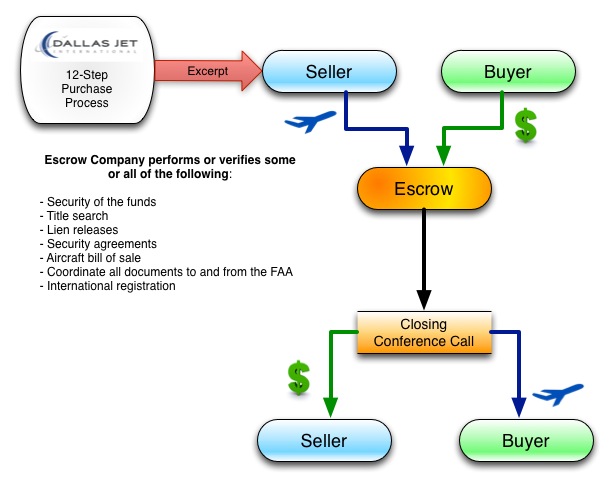
Supporting the expenses of two aircraft at the same time can involve more expense (or debt) than you can or want to support at any given time.  There are companies that Dallas Jet International works with who specialize in aircraft title transfer. These companies act as temporary holding companies that can make the purchase temporarily and lease the aircraft to you until your current aircraft sells.

Our recommendation for most clients is to use the third or fourth option – Complete each transaction independently.

Sell your airplane then buy another.  This option would provide more possibilities to negotiate the best deal on each separate transaction. We work with our clients to meet their individual needs.

DJI will make this process as painless as possible by doing the following:

  • Making the lag time between the sale and purchase as short as possible within their tolerances on price, by using less-aggressive sales techniques until the purchase process for the new aircraft is well underway before stepping up the sales efforts.  (Reverse 1031 Like-Kind Exchange)
  • Referring you to cost-effective options for temporary private transportation arrangements to bridge the gap between the sale of your old airplane and taking delivery of the new one.
  • Using an intermediary such as Time Value Property Exchange (TVPX) that will act as a holding company who will own and lease your new aircraft back to you until the sale of the old one is completed and then transfer title to you.  This option expands the financing, depreciation and tax options available.
  • Providing advice about asset exchanges, depreciation-reporting options, financing options and other resources that help you save time, money and headaches.

DJI works with you on every step of this complex process. We understand that most buyers want this to work like an automobile transaction – they simply want to buy a new airplane and dispose of their old one as profitably as possible, with as little inconvenience as possible.  Our experience and expertise will get you as close to that experience, given the complexities of the aircraft market.

More info on Like-Kind Exchanges Under IRC Code Section 1031

Whenever you sell business, investment property or aircraft and you have a gain, you generally have to pay tax on the gain at the time of sale. IRC Section 1031 provides an exception and allows you to postpone paying tax on the gain if you reinvest the proceeds in similar property or aircraft as part of a qualifying like-kind exchange. Gain deferred in a like-kind exchange under IRC Section 1031 is tax-deferred, but it is not tax-free.

The exchange can include like-kind property/aircraft exclusively or it can include like-kind property/aircraft along with cash, liabilities and property that are not like-kind. If you receive cash, relief from debt, or property/aircraft that is not like-kind, you may trigger some taxable gain in the year of the exchange. There can be both deferred and recognized gain in the same transaction when a taxpayer exchanges for like-kind property of lesser value.  Dallas Jet International works with several tax attorneys that work with our clients on tax matters.


Brad Harris

Brad Harris is founder and CEO of Dallas Jet International. Mr. Harris holds a Bachelor of Science Degree in Professional Aviation and Airway Science and a Masters Degree in human resources from Louisiana Tech University. Mr. Harris entered the aviation industry in 1989 as a corporate pilot for a Fortune 500 corporation. In 1993, he started a successful aircraft leasing and renting company which expanded to a successful aircraft management company in 1995. In 1993, Mr. Harris began his aircraft sales career and, in a very rapid fashion, became one of the most highly respected aircraft brokers in the World. In 1998, Mr. Harris started an aircraft sales, consulting, and brokerage company that is known today as Dallas Jet International. Mr. Harris is a current airline transport pilot who is type-rated in ten (10) different jet aircraft including the Gulfstream 550, 450, 350, GV, GIV, GIII, GII, Hawker 125, Falcon 10, Citation 550/500, Beechjet 400, 400A, Lockheed Jetstar II, Diamond Jet and King Air 300/350. In the many different aircraft markets, Mr. Harris parlays extensive hands-on knowledge and experience into clear results for his clientele. In addition to Mr. Harris maintaining a career focus on aircraft sales, he also has extensive experience in aviation consulting and management. Included on his client list are several clients for whom Mr. Harris and his firm have set up flight departments, consisting of aircraft crewing, aircraft management, aircraft maintenance and aircraft operating budgets. He and the firm are currently managing a Gulfstream V, a Gulfstream IV, a Falcon 50, a Citation II, a Citation ISP, a Citation Mustang, a Hawker 400XP, and two King Air 350’s.What most people do not know about Mr. Harris is that he possesses significant entrepreneurial experience in real estate and commercial insurance. This business experience, combined with his unparalleled experience in all facets of corporate aviation, has been the foundation of success for Dallas Jet International and its clients.

share save 171 16 Complex Transactions  Buy, Sell, or Trade, and in What Order?